Caffeine calculator & tracker
Add what you drank and when. We'll total it up, compare it with the FDA's commonly cited 400 mg a day for healthy adults and chart a rough estimate across your day. General information only.
01Today's drinks
Caffeine amounts are typical averages; real drinks vary a lot by bean, brew and size. Check labels when you can.
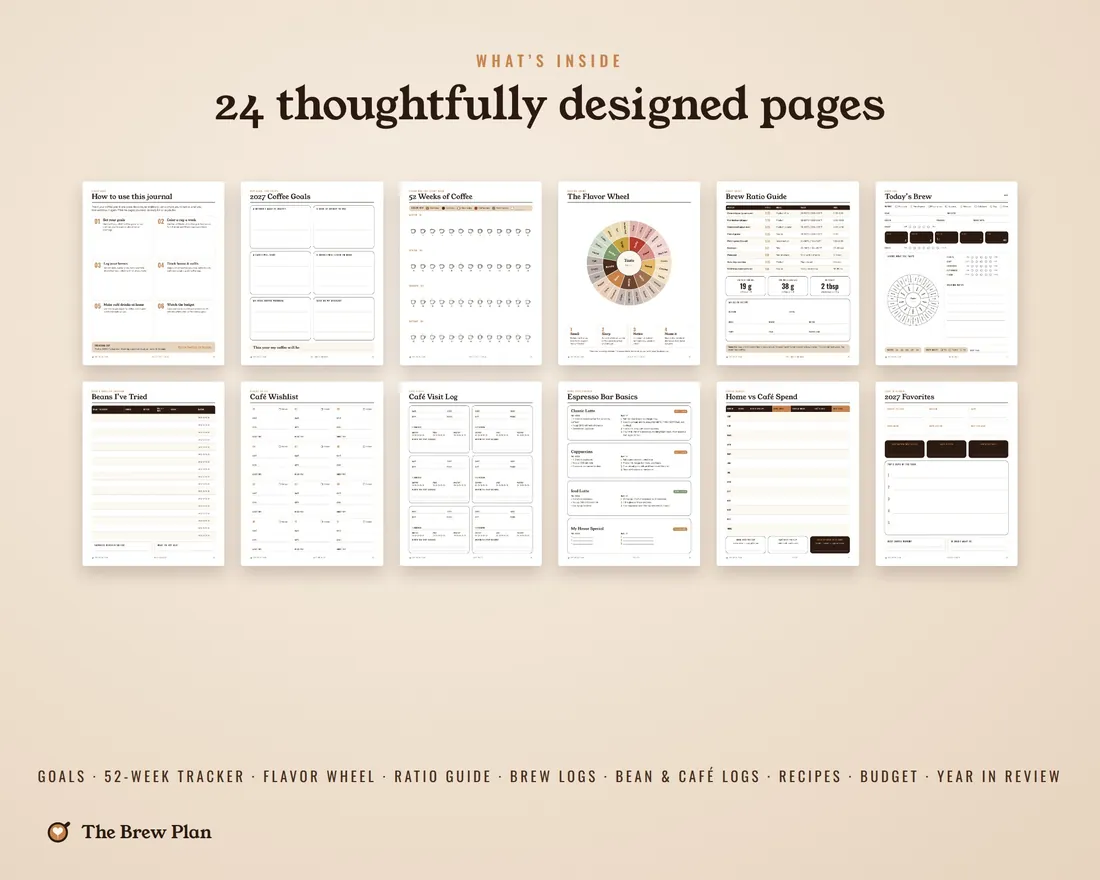
Write down the brews you love
Brew logs with dose, ratio, grind and a flavor wheel in our 2027 Coffee Journal.
See inside →Keep brewing
Coffee ratio calculator · Cold brew calculator · Home café savings calculator · Espresso ratio calculator
All 6 tools →How much caffeine is in coffee?
An 8 oz (237 ml) cup of brewed coffee typically contains about 80 to 100 mg of caffeine, and a single 1 oz shot of espresso about 60 to 65 mg. Those are averages. The real number depends on the beans (robusta has roughly twice the caffeine of arabica), how much coffee you use, the grind and brew time, and above all the size of your cup. A 16 oz café coffee can easily be two "cups" in one.
| Drink | Typical caffeine | Notes |
|---|---|---|
| Brewed coffee, 8 oz | 80–100 mg | More in a bigger mug |
| Espresso, 1 shot | about 63 mg | Lattes usually have 1 or 2 shots |
| Cold brew, 12 oz | roughly 150+ mg | Varies widely with the recipe |
| Instant coffee, 8 oz | about 60 mg | Depends on how much you scoop |
| Decaf coffee, 8 oz | about 2–15 mg | Decaf is not zero |
| Black tea, 8 oz | about 40–50 mg | Longer steeps extract more |
| Green tea, 8 oz | about 30 mg | Matcha is usually higher |
| Cola, 12 oz can | about 30–40 mg | Check the label |
Figures are rounded, typical values drawn from widely used public nutrition references. Packaged drinks list caffeine on the label, and that's always the best number to use: choose "Something else" in the tracker and type it in.
What is the 400 mg guideline?
The U.S. Food and Drug Administration has said that for healthy adults, 400 mg a day (about four or five cups of brewed coffee) is an amount not generally associated with dangerous negative effects. It is a general reference point, not a target, and it isn't right for everyone. People who are pregnant or breastfeeding, teenagers and children, and people with certain health conditions or medications are often advised to have less or none. Talk to your doctor about what's right for you.
How to use the caffeine tracker
Pick each drink from the list and set the time you had it. Tap the quick-add buttons to log a drink at the current time. If your drink has a label, choose "Something else" and type the exact milligrams, which is always more accurate than an average. The tracker totals everything, compares it with the reference amount (you can change it) and draws a simple curve of how the day adds up. Nothing is saved: refresh the page and it resets.
Where else caffeine hides
Coffee is usually the big one, but it isn't the only source. Tea, cola and energy drinks all add up, and so do some less obvious things: chocolate and cocoa, coffee-flavored desserts and ice cream, some sports and "pre-workout" products, and even certain over-the-counter medicines. Checking labels is the easiest way to get a true picture.
How the bedtime estimate works
Your body clears caffeine gradually. The time it takes to clear half of it, the half-life, is often cited as averaging around 5 hours in healthy adults, but it varies a lot from person to person. The tracker uses that average in a deliberately simple model: it assumes each drink is absorbed at the time you log it and then halves every 5 hours. It is a rough illustration to help you notice patterns (like how much of a 3 pm latte might still be around at 10 pm), not a measurement.
This tool is for general information and curiosity. It can't tell you how caffeine affects you, and it isn't medical advice. If you notice jitteriness, a racing heart or trouble sleeping, cut back and check in with a health professional.
Easy ways to enjoy coffee with less caffeine
- Go half-caf. Mix regular and decaf beans 50/50. It tastes the same and halves the caffeine.
- Switch to decaf after lunch. Good decaf has come a long way, especially in milk drinks.
- Watch the cup size. Brewing a 10 oz mug instead of 16 oz cuts caffeine by more than a third. Our ratio calculator scales any recipe.
- Dilute cold brew properly. Concentrate is strong; see the cold brew guide for serving ratios.
Related guides
Questions people ask
How much caffeine is in a cup of coffee?
Typically about 80 to 100 mg in an 8 oz cup of brewed coffee, but it varies with the beans, the amount of coffee and the cup size.
How much caffeine is too much?
The FDA commonly cites 400 mg a day as an amount not generally associated with dangerous negative effects for healthy adults. Some people should have less, including people who are pregnant or have certain health conditions. Talk to your doctor about your own limit.
Does espresso have more caffeine than coffee?
Per ounce, yes. Per drink, usually not: a single shot has about 63 mg, while an 8 oz cup of brewed coffee has about 80 to 100 mg.
Does decaf have caffeine?
A little. Decaf coffee typically has about 2 to 15 mg per 8 oz cup.
Is this caffeine tracker medical advice?
No. It gives general, typical estimates for information only. Talk to your doctor for advice about caffeine and your health.
Results are estimates for general information. Everything runs in your browser; nothing you type is stored or sent.